Today, 16 November, the Bahrain High Criminal Court has convicted 69 defendants and imposed sentences from 15 years to life imprisonment in a mass trial targeting the country’s Shia leadership. The Bahrain Institute for Rights and Democracy (BIRD) condemns the verdicts following credible allegations of torture, coerced confessions, and severe restrictions on the defence.
The proceedings involved 69 defendants, including 60 Shia clerics and nine affiliates. Fifty-six are in custody, including 47 clerics and nine affiliates, among them religious reciters known as radoods. The other 13 clerics were tried in absentia.
All 69 defendants were convicted, with 64 sentenced to life imprisonment and five to 15 years in prison. Those who received 15-year sentences are Sheikh Aziz Al-Khadran, Sheikh Ali Al-Mustarshid, Fakhri Abdullah Al-Rashid, Sheikh Ali Al-Jufairi (in absentia) and Mahdi Sahwan. No defendants were acquitted.
When delivering the verdict, the judge stated that the hearing had been brought forward from 22 November to 16 November at the request of the Public Prosecution.
The defendants faced several terrorism-related charges including establishing “a terrorist group” to overthrow the “constitutional regime” and promote Iran’s “Guardianship of the Islamic Jurist” (wilayat al-faqih) by controlling mosques and local religious gatherings.
The verdict was delivered after defence lawyers received notice at around 5pm Bahrain time yesterday, 15 November, that the judge had brought it forward from 22 November to today. The court had initially scheduled the verdict for 8 November before postponing it to 22 November. The repeated changes, including this latest decision at short notice, raised further concerns about judicial independence and the handling of the proceedings.
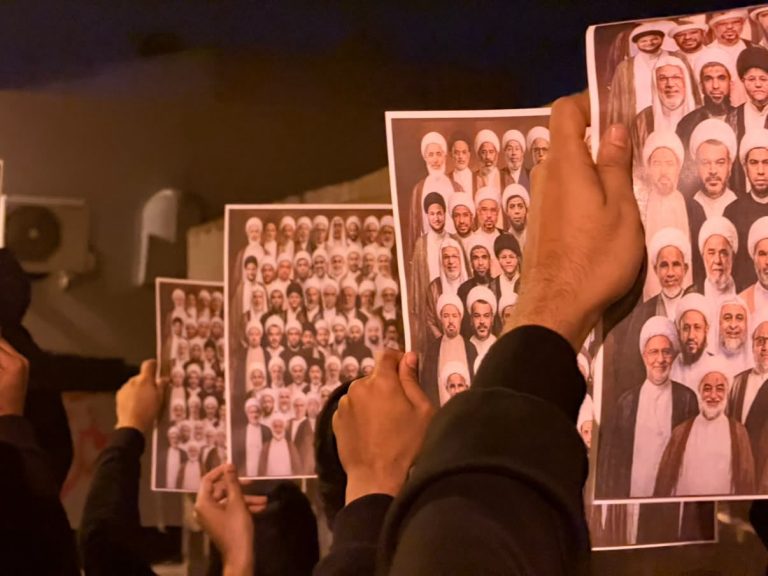
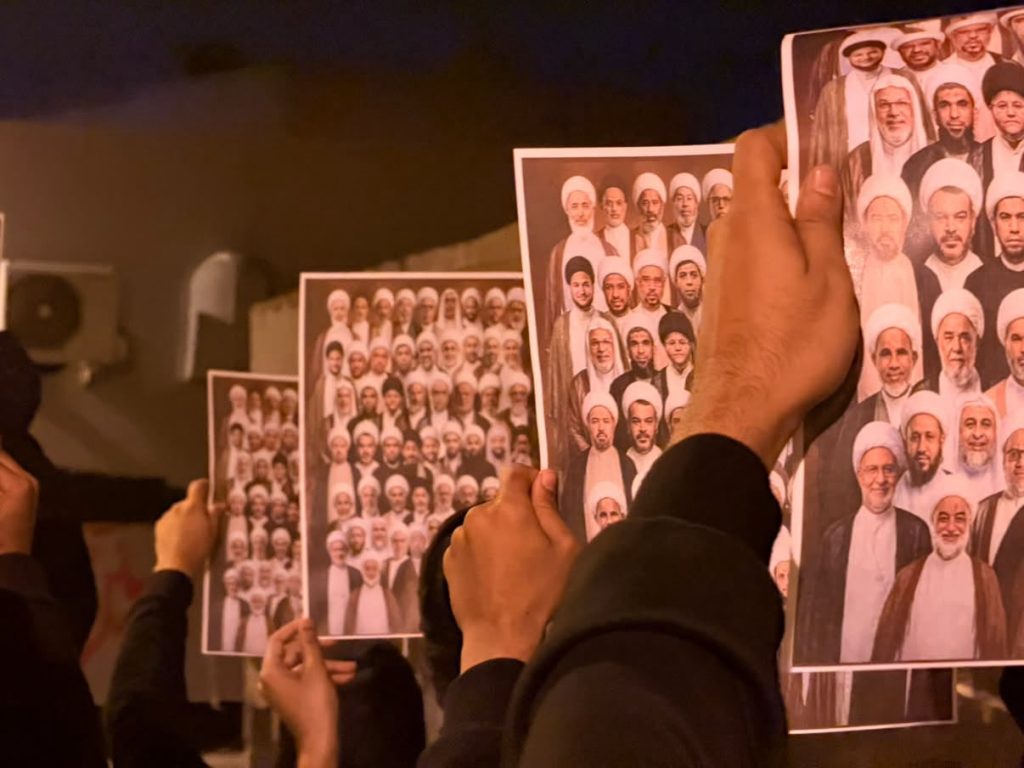
Last night, 15 November, following news on social media that the verdict had been brought forward, protests took place across several Shia areas in Bahrain, including Sitra, Al Hamala, Bilad Al Qadeem, A’Ali, Karranah, Samaheej and Abu Saiba.
Furthermore, on 15 November, the US Embassy in Riyadh published remarks by US Secretary of State Marco Rubio identifying “the Shia clerics of Iran and their expansionist mentality” as the common denominator behind major problems in the Middle East. This rhetoric amid the mass trial risks being interpreted as a green light by the Bahraini authorities to impose harsh sentences on Shia religious leaders.
Sayed Ahmed Alwadaei, Director of Advocacy at the Bahrain Institute for Rights and Democracy (BIRD), said:
“These individuals are casualties of the conflict. We condemn this deeply unjust verdict. This prosecution has torn religious leaders from their congregations and left families living under threats, fear and uncertainty. This is an attack on the faith and identity of Bahrain’s Shia community, carried out through the courts. A judiciary that fails to confront credible allegations of torture makes itself an instrument of persecution. These sentences deepen the injustice. Bahrain’s allies, particularly the UK and US, must publicly demand the end of the persecution against Shia, and urge Bahrain to release those arbitrarily detained. Rubio’s rhetoric risks emboldening Bahrain’s authorities at a time where these clerics urgently need international protection. Washington must make clear that its alliance with Bahrain offers no licence for religious persecution, torture or convictions based on coerced confessions”.
Torture allegations and disputed confessions
BIRD’s documents several accounts which describe detention at undisclosed locations, interrogation without lawyers, prolonged blindfolding and handcuffing, forced standing, sleep deprivation and threats of sexual violence against defendants and their relatives. Some defendants reported being prevented from revealing their location for several days even when permitted to telephone their families.
The alleged coercion continued at the Public Prosecution. Defendants describe brief interviews followed by pressure to sign lengthy statements they were not allowed to read, under threat of being returned to the Criminal Investigation Directorate for further abuse. They deny questions and answers attributed to them. Identical passages appear across different defendants’ purported confessions.
The defence was prevented from obtaining copies of case files exceeding 6,700 pages and had to rely on handwritten notes made under severe time limits. Those in custody participated by video link after requests for their attendance in court were denied.
When lawyers sought recordings to test these accounts, they were told the footage had been deleted after one month. The UN Committee against Torture (CAT) had already called for interrogations in all places of custody to take place in rooms equipped with video or audio surveillance. Recordings that cannot be examined offer no protection to a defendant challenging the account of his interrogation.
BIRD’s review of a memoranda issued by the Special Investigation Unit (SIU) – a government watchdog which falls under the authority of the Public Prosecution and is mandated with investigating torture allegations – raises grave concerns that the SIU did not thoroughly investigate torture allegations, shielding suspected perpetrators and lending credibility to potentially coerced confessions. CAT had already warned that Bahrain’s existing investigation bodies lacked independence and effectiveness.
For example, in the case of Sheikh Mohammed Saeed Al-Taitoon, 62, he reported being blindfolded and restrained for a week, forced to stand despite severe urinary bleeding and kidney stones, denied necessary surgery and threatened with the revocation of his family’s citizenship. He says a prosecution interview lasting about five minutes became a record of more than 150 questions and attributed answers, most of which he denies. The Special Investigation Unit’s own records documented psychological deterioration, supported by a fellow detainee’s observations and a medical assessment identifying depression, anxiety and poor concentration. Yet it dismissed his allegations as unsubstantiated. BIRD said the SIU relied on an inconclusive assessment of what caused his symptoms instead of properly pursuing recordings and other evidence that could establish what happened.
A prosecution reaching into religious life
The authorities brought terrorism-related charges, including allegations of an unlawful organisation and terrorist financing. Only one of the 56 detainees was charged with espionage. BIRD’s concern is that religious teaching, books, khums, charitable contributions and contacts with religious authorities abroad have been used as criminal evidence. Shared belief and religious practice cannot substitute for proof of individual criminal responsibility.
Among those prosecuted are scholars who led major congregations, including Sheikh Mohammed Sanqour and Sheikh Ali Al-Sadadi of the Imam Al-Sadiq Grand Mosque in Duraz. Their removal disrupts worship, teaching and religious guidance far beyond the individuals in the dock.
Investigate torture and remedy unsafe convictions
In a joint statement dated 6 November, 20 human rights organisations, including BIRD, Amnesty International, Human Rights Watch and the World Organisation Against Torture, warned that the mass prosecution raised serious concerns of religious persecution targeting the religious life and leadership of Bahrain’s Shia community. They highlighted allegations of torture, coerced confessions, incommunicado detention and secret proceedings, alongside restrictions that denied lawyers meaningful access to the evidence. The organisations called for fair trials, the exclusion of coerced confessions, the immediate release of those arbitrarily detained and the dropping of charges based on peaceful religious activities. They also demanded independent investigations, effective remedies for victims and accountability for security officials, prosecutors and others implicated in torture, coercion or the concealment of abuse.
BIRD called for independent investigations into torture, enforced disappearance and prosecutorial coercion; preservation and disclosure of recordings and custody records; urgent medical care; and accountability for officials implicated in abuse or its concealment. Convictions secured through fundamentally unfair proceedings must be set aside. No one should remain imprisoned on the strength of a coerced confession.
END