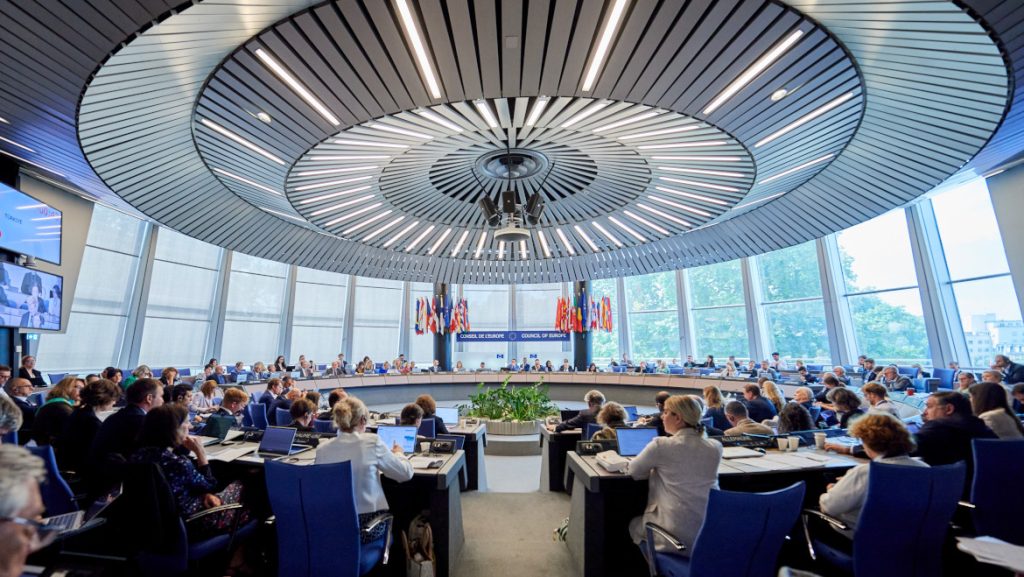
Following a meeting on 15 and 16 September 2026, the Committee of Ministers of the Council of Europe has released a decision that calls on Serbia to do more to implement the unanimous judgment of the European Court of Human Rights in Ali v. Serbia (no. 4662/22, 25 March 2025).
In the judgment, the Court held that Serbia had violated Article 3 of the European Convention on Human Rights, which safeguards against torture and inhuman or degrading treatment or punishment, when the Serbian courts had failed to examine Bahraini dissident Ahmed Jaafar’s complaint that he would face a risk of ill-treatment if extradited to Bahrain. The Court also held that Serbia had violated Article 34 of the Convention, which gives individuals the right to make applications to the Court, by going ahead with his extradition to Bahrain in contravention of an interim measure indicated by the Court on 21 January 2022. The Court ordered Serbia to pay EUR 9,800, plus any tax chargeable and interest in the event of a default in payment.
The decision of the Committee of Ministers records that, since the judgment, Serbia has placed a sum of money for Ahmed Jaafar in a deposit account in a domestic court. However, the Committee acknowledged his legal representatives’ argument that there are ‘difficulties in complying with the conditions for the release of the funds given the exceptional nature of [Ahmed Jaafar’s] situation’ of ongoing detention in Bahrain. Accordingly, the Committee indicated that Serbia should ‘co-operate with [his] representatives and the Secretariat to find solutions to enable the release of funds to take place without delay’.
The Committee’s decision also records ‘diplomatic steps already undertaken by the [Serbian] authorities to obtain information from the Bahraini authorities on [Ahmed Jaafar’s] current situation and to ensure that his rights under Article 3 are duly protected’. Noting Ahmed Jaafar’s legal representatives’ submissions concerning his ongoing maltreatment in Bahraini detention, the decision adds that these authorities are to ‘continue their efforts in this respect and to keep the Committee informed, to the extent possible, of any relevant developments’ as well as ‘undertake that, should they receive information that [Ahmed Jaafar] may risk treatment contrary to Article 3 of the Convention, they will take all possible measures within their competence to secure the effective protection of’ his rights under the Convention.
The decision also makes indications concerning general measures to be adopted by Serbia to improve the human rights situation in Serbia as relevant to the Court’s judgment. The Committee’s role in supervising the execution of the judgment under Article 46 of the Convention continues.
Sayed Ahmed Alwadaei, Director of Advocacy at the Bahrain Institute for Rights and Democracy (BIRD), commented:
‘It was very hard to hear Ahmed describing to me the degrading conditions he is living in at Jau Prison. He is stuck in a severely overcrowded cell, has repeatedly had to resort to hunger strikes just to secure basic rights, and has been in and out of solitary confinement.
This decision is an important reminder that Serbia cannot simply take Bahrain’s assurances at face value. It must face the reality of what happened after Ahmed’s unlawful extradition and do everything it can to protect him.’
Lawyers Marko Štambuk, Rodney Dixon KC, and Sebastian Bates, who represented Ahmed Jaafar before the Court and continue to do so before the Committee, added:
‘We welcome this decision of the Committee of Ministers. It reflects that, while Serbia has taken certain steps to implement the judgment of the Strasbourg Court concerning Ahmed Jaafar, there is much more to be undertaken. Serbia must do everything in its power to protect Ahmed Jaafar from violations of his rights in Bahrain. In our view, Ahmed Jaafar’s circumstances in Bahrain are such that this will likely mean in the end that Serbia must negotiate with Bahrain for his return to Serbian territory, where he was prior to his unlawful extradition in 2022. In the meantime, the Serbian authorities must be in effective contact with their Bahraini counterparts and must cooperate with us to secure payment of the whole sum ordered by the Strasbourg Court.’